The question always arrives in the same season, usually from somebody who has just finished a fortnight of coastal cruising and has started reading pilot charts in the evenings. Yacht or sailboat for a real crossing? We have been asked it often enough to know that the honest answer has very little to do with which boat is nicer to sit on. It comes down to how you intend to buy the miles: with fuel, or with time.
Where each one wins
- Sailboat: effectively unlimited range, lower running costs, demands real skill and patience.
- Motor yacht: predictable schedule and far more comfort at anchor, but only a displacement hull belongs offshore.
- On a long passage both average roughly the same speed, somewhere around 6 knots.
- Budget close to 10% of the purchase price every year to run either one, before any finance.
- 1 Long distance is not the same problem for the two hulls
- 2 The arithmetic of a crossing, in real numbers
- 3 Range is where the comparison stops being fair
- 4 What a year costs, whichever way you go
- 5 Crew, watches and the skill the boat asks of you
- 6 Safety equipment and insurance are not universal
- 7 How we would choose
Long distance is not the same problem for the two hulls
A sailboat and a motor yacht meet the ocean with completely different constraints, and lumping them together as « boats » hides the only thing that matters. A cruising sailboat converts wind into miles, so its limit is the crew’s stamina and the food aboard. A motor yacht converts diesel into miles, so its limit is arithmetic.
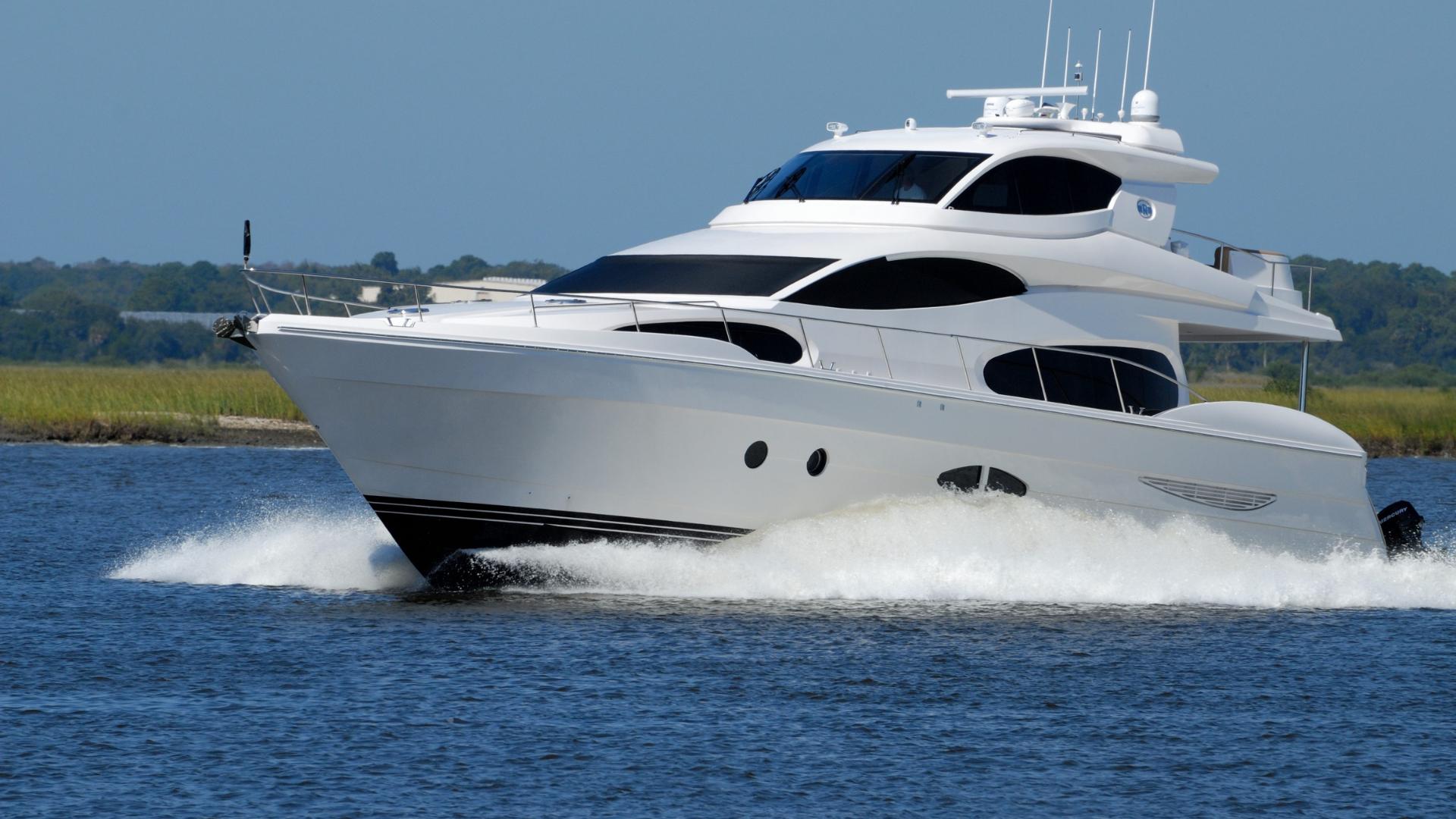
That arithmetic is brutal on the wrong hull. A 50-foot planing flybridge is a superb coastal boat with a beautiful cabin, and it is still a coastal boat: push it to a cruising speed it was designed for and the tanks empty in a few hundred miles. Only a full displacement hull, running slowly and heavily built, turns a motor yacht into an ocean vessel. If the difference between hull types is new to you, it is worth reading what actually separates a boat from a yacht before you go shopping.
The arithmetic of a crossing, in real numbers
A cruising boat of either type covers far less ground per day than most people expect. The World Cruising Club’s Atlantic Rally for Cruisers runs 2,700 nautical miles from Las Palmas to Saint Lucia, and the bulk of the fleet takes somewhere between 18 and 21 days. That works out at roughly 130 to 150 miles in each 24 hours, or an average of about 5.5 to 6.5 knots including the calms.
People quote the ARC record at 8 days and 6 hours, set by the maxi Rambler 88 in 2016, as if it were a benchmark. It is not. That is a racing machine with a professional crew, and it tells you nothing about what a family boat will do.
The point for this comparison is that a displacement motor yacht crossing at 7 or 8 knots is doing almost exactly what the sailing fleet does. You are not buying speed. You are buying certainty of schedule, which is a different thing.
https://www.youtube.com/watch?v=c7p-o0dblK0
Range is where the comparison stops being fair
Fuel range is the single hardest number in this whole debate, and it is the one most often inflated. Take the Nordhavn 41, a genuine small passagemaker: it carries 900 US gallons. Early published figures suggested more than 8,200 miles at 6 knots, which sounded extraordinary because it was theoretical. Jim Leishman of builder PAE later told Passagemaker that those numbers had not been asked to survive the real world, and that a realistic expectation is closer to 3,500 nautical miles once wind, sea state, stabiliser drag and the hotel load are counted.
Three and a half thousand miles is still a remarkable figure for a 41-foot motor boat, and it crosses the Atlantic with margin. But notice what happened: the honest number was well under half the brochure one. A sailboat never has that conversation, because nobody publishes an optimistic range figure for wind.
What a year costs, whichever way you go
Both vessels are expensive to keep, and the usual rule of thumb is to budget about 10% of the purchase price annually for running costs: berthing, insurance, haul-out, antifouling, servicing and fuel. It is a rule of thumb rather than a law, and brokers who use it are the first to say it holds up best on modest boats kept in an ordinary marina.
Scale up and it stops being conservative. A larger yacht with a deep-water slip, professional yard labour and a serious fuel burn will pass 10% comfortably. And the figure excludes two things owners always forget: loan interest, and the depreciation that hits hardest in the first few years of a new boat.
Between the two, the sailboat wins on fuel and loses a little on rigging. Standing rigging, sails and running rigging all wear out on a calendar, not on a clock, and replacing a suit of sails is not a small invoice.
Crew, watches and the skill the boat asks of you
This is where most crossings are actually decided. A sailboat asks you to reef at three in the morning, read a weather routing forecast properly, and keep a watch system running for three weeks with two or three people. It is learnable, and thousands of couples do it every year, but it is not a weekend skill.
A motor yacht is easier to drive and harder to nurse. There is no sail handling, but there is an engine room that has to be inspected under way, in motion, every few hours. A single mechanical failure mid-ocean is a very different situation from a torn sail.
One line we will not soften: anything touching the rig, the steering, the through-hulls or the engine mounts belongs to a qualified marine professional, not to a confident owner with a socket set. Offshore is the wrong place to discover a DIY compromise.
Safety equipment and insurance are not universal
Every jurisdiction sets its own rules, so treat the following as a checklist to verify locally rather than a legal statement. Almost everywhere, a vessel going offshore is expected to carry lifejackets for everyone aboard, fire extinguishers, distress signals and, for ocean work, a liferaft and an emergency beacon. Requirements differ by flag state and by cruising area, and your national maritime authority is the reference that counts.
Insurance is a separate hurdle. Underwriters routinely impose minimum crew numbers, minimum logged miles or a named qualified skipper before they will cover an ocean passage, and those conditions often decide the boat you end up buying. Ask the insurer before the broker.
| Criterion | Cruising sailboat | Displacement motor yacht |
|---|---|---|
| Typical passage average | 5.5 to 6.5 knots | 7 to 8 knots |
| Effective range | Limited by stores, not fuel | Fixed, and lower than brochures suggest |
| Schedule reliability | Weather dependent | Predictable within reason |
| Comfort at anchor | Adequate | Considerably better |
| Skill demanded | High, and constant | Lower to drive, higher to maintain |
| Best suited to | Owners with time and an appetite for sailing | Owners with a budget and a calendar |
How we would choose
If the voyage itself is the point, take the sailboat. If the destination is the point and the diary is fixed, take the passagemaker and accept the fuel bill. If neither answer feels obvious, the honest reading is that you are not choosing a boat yet, you are choosing a way of spending three weeks.
Can an ordinary flybridge motor yacht cross an ocean?
Not on its own bottom, in most cases. Planing production yachts are built for coastal range and sea states, and the ones that do cross are typically shipped on a transport vessel rather than driven.
Is a catamaran a third option?
It is, and a popular one. Cruising catamarans offer more living space and a flatter motion downwind, at the cost of marina fees that are often charged at a multihull premium.
How much experience should I have before an ocean passage?
Enough that night sailing, heavy weather and a broken piece of gear are all things you have already handled near shore. Formal training through a recognised body, and a delivery trip as crew, are the two fastest ways to get there.
Which holds its value better?
Well-known bluewater sailboats tend to hold value steadily because the buyer pool is specific and loyal. Motor yachts depreciate faster in the early years, which cuts both ways: a painful sale for the first owner is a good buy for the second.
Not ready to commit to either one?
Owning is only one route to a long passage, and it is not always the sensible one for a first ocean crossing.
Updated August 2026. Sources: World Cruising Club (ARC route and fleet passage times), Passagemaker (Nordhavn 41 range, interview with Jim Leishman of PAE), yacht brokerage guidance on the 10% annual running cost rule. Regulatory and insurance requirements vary by country and by cruising area, and this article is general information rather than legal or safety advice.