Golf carts have evolved far beyond their original purpose. Once limited to transporting players across fairways, they are now widely used in hospitality, tourism, logistics, private estates, industrial campuses, and urban environments. As their role expands, so does the demand for reliability, autonomy, and efficiency.
At the heart of this transformation lies a technological shift: the transition from traditional lead-acid batteries to lithium-based energy systems.
Understanding this evolution helps explain not only how golf carts are changing, but also how energy management itself is becoming smarter, more sustainable, and more aligned with modern mobility needs.
- 1 The Limits of Traditional Battery Systems
- 2 Lithium Technology: A Structural Shift
- 3 Weight, Performance, and Vehicle Design
- 4 Maintenance-Free Operation
- 5 The Rise of Connected Energy Systems
- 6 Sustainability and Environmental Impact
- 7 Adapting to Expanding Use Cases
- 8 Toward Smarter Fleet Management
The Limits of Traditional Battery Systems
For decades, lead-acid batteries powered the majority of electric golf carts. They were affordable and widely available, making them the default solution for fleet operators.
However, their limitations became increasingly evident over time:
- High maintenance requirements
- Long charging times
- Significant weight
- Performance degradation over repeated cycles
- Limited lifespan
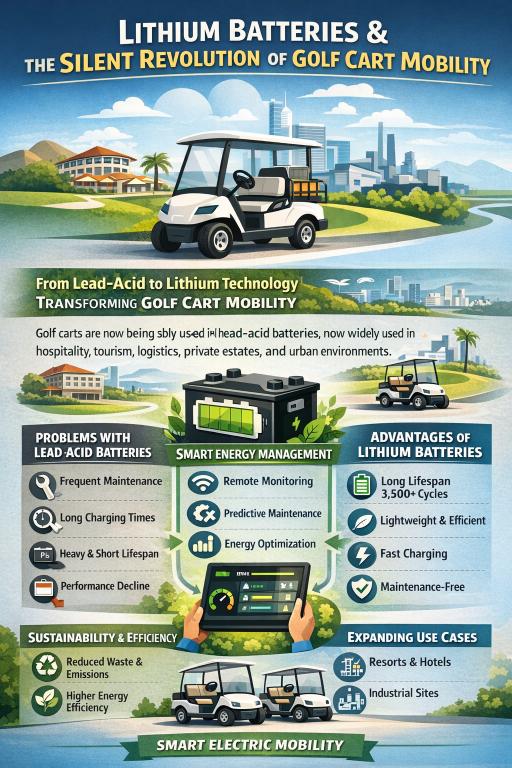
These constraints directly impact operational efficiency. A fleet of golf carts that requires frequent maintenance or battery replacement generates downtime and hidden costs, especially in environments where vehicles are used intensively.
As usage scenarios diversified (from resorts and campsites to industrial sites and last-mile mobility) it became clear that traditional energy storage was no longer aligned with modern expectations.
Lithium Technology: A Structural Shift
Lithium battery technology represents more than a simple upgrade. It is a structural change in how electric mobility systems are designed and operated.
One of the most significant advantages is lifespan. Lithium batteries can achieve several thousand charge cycles, far exceeding older technologies. Some modern solutions are designed for more than 3,500 cycles, dramatically reducing replacement frequency and extending operational continuity.
Another key benefit is energy efficiency. Lithium systems maintain stable voltage levels throughout their discharge cycle, which means:
- Consistent performance on slopes
- Reliable acceleration
- Predictable range
In practical terms, this translates into smoother daily operations ; whether transporting guests across a resort or supporting logistics within a large facility.
Weight, Performance, and Vehicle Design
Lithium batteries are significantly lighter than lead-based alternatives. This reduced weight has several direct consequences:
- Less strain on mechanical components
- Improved vehicle handling
- Increased energy efficiency
A lighter battery pack allows golf carts to operate longer using the same amount of stored energy. It also opens new design possibilities for manufacturers and fleet operators, enabling vehicles to be optimized for different terrains and usage intensities.
Modern lithium battery packs can also be tailored to match moderate or intensive use profiles, ensuring that autonomy and power align with real-world needs rather than theoretical specifications.
Maintenance-Free Operation
Maintenance has long been one of the most underestimated operational burdens in golf cart fleets.
Traditional systems require:
- Water refilling
- Regular inspections
- Corrosion management
Lithium batteries eliminate most of these tasks. Their sealed architecture allows them to operate without ongoing intervention, significantly reducing labor requirements and simplifying fleet management.
Maintenance-free operation is not just a convenience, it fundamentally changes cost structures over time. According to industry data, lithium solutions can reduce total cost of ownership compared to lead-based systems by lowering servicing needs and extending lifespan.
The Rise of Connected Energy Systems
Perhaps the most transformative aspect of modern lithium batteries is not chemical, but digital.
The integration of connectivity into battery systems introduces entirely new capabilities:
- Real-time performance monitoring
- Predictive maintenance
- Usage optimization
- Remote diagnostics
Instead of reacting to failures, operators can now anticipate them.
By continuously tracking parameters such as temperature, voltage, and usage patterns, connected systems help prevent premature aging and ensure that batteries operate within optimal conditions.
Some platforms even allow fleet managers to monitor multiple vehicles simultaneously, offering a centralized view of energy health across an entire operation. This shift from reactive to proactive maintenance represents a major step forward in operational efficiency.
Companies like BatConnect are contributing to this evolution by embedding intelligence directly into lithium battery systems, enabling real-time monitoring and adaptive performance management across electric vehicle fleets.
Sustainability and Environmental Impact
Environmental considerations are increasingly shaping mobility decisions, even in sectors as niche as golf cart transportation.
Lithium batteries support sustainability in several ways:
- Longer lifespan reduces material waste
- Higher efficiency lowers energy consumption
- Reduced replacement frequency minimizes lifecycle emissions
Compared to older technologies, lithium solutions can significantly lower environmental footprint over time by reducing the number of batteries required across a vehicle’s lifespan.
Additionally, modern eco-design approaches focus on recyclability and resource optimization, aligning energy storage with broader circular economy principles.

Lithium batterie golf cart mobility
Adapting to Expanding Use Cases
Golf carts are no longer confined to golf courses. Today, they are used in:
- Tourist resorts
- Hotels
- Industrial sites
- Event venues
- Residential communities
Each environment presents different challenges, from terrain variations to usage intensity.
Lithium battery systems offer the flexibility needed to adapt to these diverse contexts. With modular capacities and compatibility across vehicle models, they can be integrated into a wide range of light electric mobility platforms.
This adaptability supports the growing role of golf carts as practical mobility tools rather than purely recreational vehicles.
Toward Smarter Fleet Management
The future of golf cart mobility is not just electric, it is intelligent.
Energy systems are becoming active components of vehicle ecosystems rather than passive storage units. Through connectivity, data analysis, and predictive management, batteries now contribute directly to operational optimization.
This evolution reflects a broader trend across mobility sectors: performance is no longer defined solely by hardware, but by the ability to manage and optimize energy usage dynamically.
The transition to lithium batteries is reshaping how golf carts are powered, maintained, and managed.
By combining durability, efficiency, reduced maintenance, and digital intelligence, lithium technology enables golf carts to meet the demands of modern mobility environments.
As these vehicles continue to move beyond fairways into logistics, hospitality, and urban applications, advanced battery systems will play an increasingly central role ; not only in extending range and lifespan, but in redefining what lightweight electric mobility can achieve.