Your own harbour you could enter blindfolded. A strange one at six in the evening in August, with a crosswind, a fuel queue and no idea which finger you have been given, is a completely different exercise. The good news is that marinas are far more standardised than they look from the water, and the sequence you follow is close to identical whether you are arriving in Brittany, the Solent or the Var.
Before you reach the wall
- Call five to ten minutes out on VHF 9: boat name, length overall, beam, draught, how long you want to stay.
- Three knots inside the basins is the common limit, not two. La Rochelle allows 5 knots in the access channel and 3 in the basins; Port Vauban in Antibes posts 3 knots throughout.
- Sailing, swimming and windsurfing inside the port are generally prohibited. Come in on the engine.
- In Europe you leave red marks to port when entering from seaward. In the Americas, Japan and Korea it is the exact opposite.
- 1 Step 1. Call before you commit to the entrance
- 2 Step 2. Three knots, not two
- 3 Step 3. Under engine, and give way sensibly
- 4 Step 4. The buoyage flips depending on where you are
- 5 Step 5. The numbers they will ask for
- 6 Berthing, paperwork and water
- 7 Fuel is a timing problem, not a queueing problem
Step 1. Call before you commit to the entrance
Hail the capitainerie on VHF channel 9 while you still have room to turn around. Five to ten minutes out is about right. Any later and the office is answering you while you are already in the gap, which helps nobody.
Keep the call short and in a fixed order, because that is the order the office needs it: boat name, length overall, beam, draught, and how many nights you want. In some ports you will also be met at the channel entrance by a staff member in a rib or on a floating pontoon, who will ask you the same questions again. That is normal, not a sign that the radio call failed.
If you are coming into somewhere genuinely unfamiliar, the approach is worth setting up on the plotter before you get close, and our beginner’s guide to using a marine GPS covers the habit of building the route at the dock rather than improvising it at sea.
Step 2. Three knots, not two
The figure most often posted inside a marina basin is 3 knots, and it is a legal limit rather than a suggestion. The exact number belongs to each port’s own règlement particulier de police, so it varies: La Rochelle publishes 5 knots (about 9 km/h) in the access channel and 3 knots (about 5.5 km/h) in every basin, while Port Vauban in Antibes applies 3 knots from the passage onwards. Police and rescue craft on a mission are the usual exception.
The reason is wash, not speed for its own sake. A boat doing six knots between pontoons throws a wake that snatches at mooring lines and bangs hulls against fenders for a hundred metres behind it, and in a windy basin that is how damage happens.
Port speed limits are enforced. In French waters that enforcement falls to the harbour authority and the maritime police, and the fine is a real one.
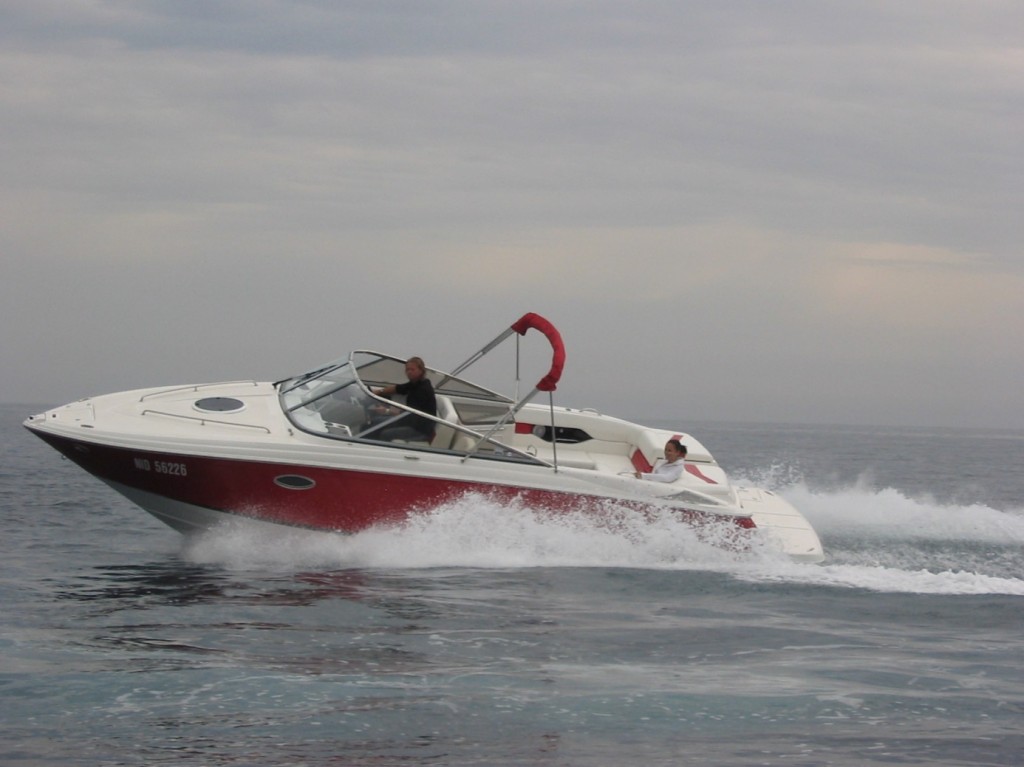
Excessive speed in a port can be punished with a fine by marine police
Step 3. Under engine, and give way sensibly
Inside port limits you use whichever means of propulsion gives you the most manoeuvrability, which in practice means the engine. French port regulations are explicit that sail is the last resort inside the harbour, and they generally prohibit sailing, swimming and windsurfing in the basins altogether.
Priority inside a marina is less about right of way than about not creating a knot. The rule at La Rochelle is a good general model: a boat moving between two pontoons gives way to a boat navigating in a main channel. Tows, sail school flotillas under tow, rescue craft and port authority boats come before everyone.
Step 4. The buoyage flips depending on where you are
Coming in from seaward in Europe, red marks stay on your port side and green on your starboard. That is IALA Region A, which covers Europe, Africa, Australia, New Zealand, India and most of Asia.
Cross to the Americas, Japan, Korea or the Philippines and you are in Region B, where the colours are reversed and the mnemonic becomes « red right returning ». The two-region system dates from the unified scheme IALA published in 1976, after two serious collisions in the Dover Strait in 1971. It is the single most likely thing to catch out an experienced skipper on their first foreign season, precisely because the habit is so deeply ingrained.
Step 5. The numbers they will ask for
Being asked your draught and having to go below to look it up is the classic novice moment, and it happens because nobody tells you which four numbers matter. These are they.
| Figure | Why the office wants it | Where to find it |
|---|---|---|
| Length overall | Decides which category of berth and which tariff you fall into | Registration document and builder’s specification |
| Beam | Decides whether you physically fit the box or the finger offered | Builder’s specification |
| Draught | Decides whether you can reach the berth at that state of tide | Registration papers or handover file, and worth checking against the actual keel |
| Air draught | Matters wherever a lifting bridge, lock or overhead cable is involved | Rig specification, measured from the waterline |
Write all four on a card and tape it near the chart table or the helm. It takes ten minutes and it saves the one conversation nobody wants to have on the radio.
Berthing, paperwork and water
Do not take a vacant finger because it looks free. Use the visitors’ berths or the holding pontoon if the port publishes one, and wait to be allocated. An empty berth in August almost always belongs to somebody who is out for the day and will be back at seven.
Ask for a hand if you are short-handed. Marina staff take lines for a living and would far rather walk to your berth than deal with the consequences of a solo skipper trying to do everything at once in a crosswind.
Then walk up to the capitainerie with your papers. Expect to be asked for the boat’s registration document, the insurance certificate with the policy number, an arrival form, and your intended departure date. Access to water and shore power is issued at the same desk.
Fuel is a timing problem, not a queueing problem
Tell the office you are coming in for fuel rather than a berth, so they can check whether the station has room before you commit to the channel. Large motor yachts can occupy a fuel berth for a couple of hours while they take on several thousand litres, and a marina that looks quiet from outside can have a two-boat queue you cannot see.
The other half of the problem is the clock. Around six in the evening, charter and day-hire boats come back in a block and every one of them has to refuel before handover. Fuelling at nine in the morning takes ten minutes. The same job at six in the evening in season can take an hour.
Which channel should I call on if the pilot book says something else?
Follow the pilot book or the port’s published information. Channel 9 is the usual working channel for marinas in France and in much of Europe, but it is not universal, and channel 16 is for distress and initial contact rather than berth allocation.
What if I arrive at night?
Many marinas take night arrivals, with the entrance lit and the office reachable on the radio or by phone, but the berth allocation may wait until morning. Identify the entrance lights and their characteristics from the chart before you approach, not after.
Do these rules apply everywhere?
The sequence does. The specific figures do not. Speed limits, priority rules, required documents and even the buoyage convention change from port to port and from region to region, so read the local port regulations and the current pilot book for the harbour you are entering, and ask the harbour office if anything about the approach is unclear.
Arriving in poor visibility?
A busy harbour approach in fog or at night is where radar earns its price, and where knowing how to read it matters more than owning it.
Published 2014. Fully rewritten in August 2026. Speed limits and port procedures cited are those published by the ports concerned and may change; always check the current local regulations.