Moving a valuable painting, an antique cabinet or a delicate sculpture across borders is very different from sending an ordinary parcel. Historical significance and fragile materials can make damage especially consequential. A successful shipment therefore depends on careful preparation, suitable packaging and coordination between everyone involved.
Whether you are a private collector, an antique dealer or a gallery preparing for an exhibition, understanding the main stages of international art transport can help you avoid costly mistakes. Specialist services such as those described at transports-mari.com/en combine packing, transport, customs procedures and storage.
- 1 Start With a Detailed Assessment of the Object
- 2 Why Custom Packaging Matters ?
- 3 Choose the Most Appropriate Transport Method
- 4 Understand Customs and Cultural Heritage Requirements
- 5 Plan Collection and Handling Carefully
- 6 Consider Storage Conditions Along the Route
- 7 Check Insurance Before Shipping
- 8 Prepare for Delivery and Unpacking
- 9 A Successful Shipment Begins Before Departure
Start With a Detailed Assessment of the Object
The first step is to understand exactly what is being shipped. A framed oil painting, a marble statue and a nineteenth-century wooden desk do not face the same risks. Their weight, dimensions, materials and existing condition determine how they should be handled.
Create an inventory containing photographs, measurements, descriptions and any available documentation of provenance or value. Photographs should record both the overall appearance and vulnerable details, such as corners, decorative elements or previous repairs.
A condition report is especially useful before valuable pieces change hands. It establishes their state before packing and provides a reference when they are unpacked. Fragile or historically important objects may also require a conservator’s advice.
Why Custom Packaging Matters ?
Protective packaging must be designed around the object rather than forcing the object into a standard box. A painting may need rigid protection against pressure, while an antique mirror requires cushioning that does not place stress on its frame or glass.
Specialist packers can select suitable materials, internal supports and made-to-measure wooden crates. The goal is to limit movement, absorb vibration and prevent accidental contact with vulnerable surfaces. Fragile finishes should never be wrapped directly in materials that might stick, scratch or transfer chemicals.
Crate design also depends on the route. A journey involving several loading points may expose the shipment to repeated handling. International wooden packaging may additionally need to meet applicable treatment and marking requirements.
Clear identification, handling instructions and a packing record help everyone involved understand how each item should be moved.
Choose the Most Appropriate Transport Method
International art shipments can travel by road, air or sea. The choice depends on distance, urgency, dimensions, sensitivity and budget.
Road transport is often practical for journeys within Europe. It can offer flexible collection and delivery arrangements and, where suitable, reduce the number of transfers between different vehicles.
Air freight is useful when deadlines are tight or pieces need to reach distant destinations relatively quickly. However, airport handling, security procedures and transfers still require careful coordination.
Sea freight may be considered for large furniture, substantial collections or bulky crates. Longer transit times make packaging, moisture management and storage conditions particularly important.
Price alone is not decisive. Assess the complete journey, including collection, loading, intermediate storage, customs processing and final installation.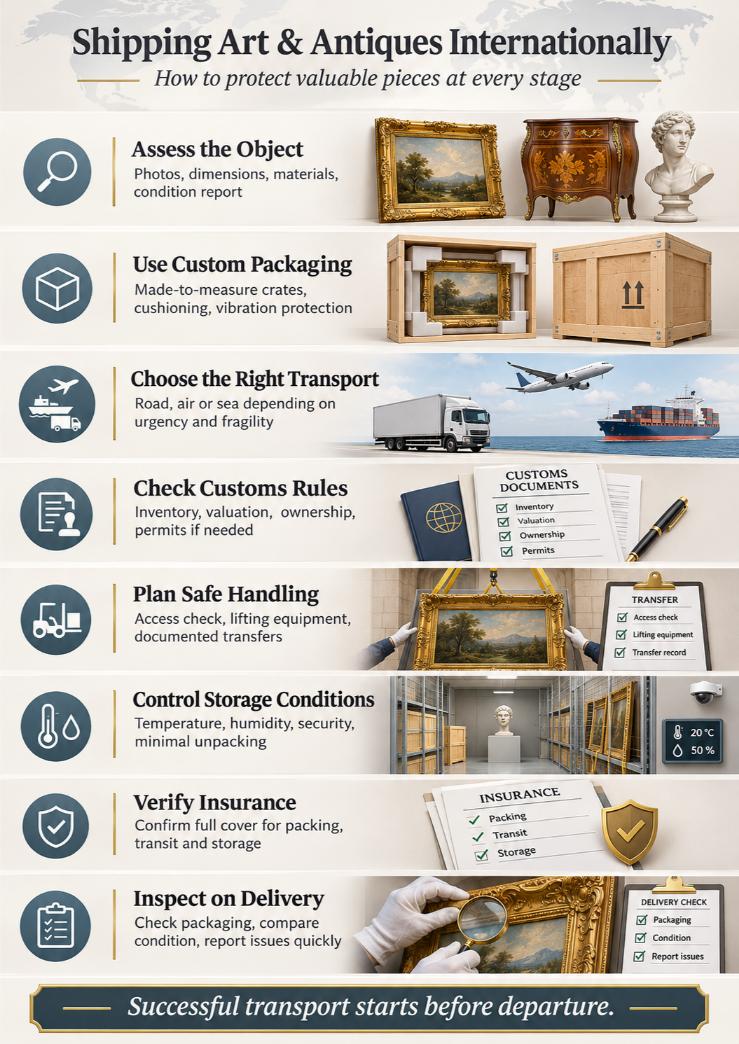
Understand Customs and Cultural Heritage Requirements
Cross-border transport is not simply a question of booking space on a vehicle. Import and export formalities can vary according to the countries concerned, the nature of the object and whether the shipment represents a sale, a relocation or a temporary exhibition.
Supporting documents may include an itemized inventory, commercial invoice or valuation, proof of ownership and transport records. Certain cultural objects may require an export licence or other authorization, depending on their age, value, category and national rules.
Antiques containing protected animal or plant materials can face additional restrictions.
Temporary shipments for fairs or exhibitions can involve different customs arrangements from permanent exports. Clarifying the purpose of the movement early helps determine which procedures and supporting documents are needed.
Because incomplete paperwork can delay delivery, customs requirements should be checked before packing and departure, not when the shipment arrives at the border.
Plan Collection and Handling Carefully
Many incidents occur before an object reaches the main transport vehicle. Tight staircases, narrow doorways, uneven floors and unsuitable lifting equipment can create avoidable hazards.
A preliminary assessment of the collection and delivery locations allows the team to anticipate access restrictions and organize the necessary staff and equipment. Large furniture may require special handling, while oversized works sometimes need a carefully planned exit route.
Each transfer should be documented and controlled. When responsibility passes between a collector, a warehouse, a carrier and a recipient, clear records reduce uncertainty about where the piece is and who is handling it.
Consider Storage Conditions Along the Route
Not every shipment travels directly from one address to another. Storage may be necessary while awaiting customs clearance, an exhibition opening or access to the final destination.
The environment matters as much as physical security. Rapid changes in temperature or humidity can affect wood, canvas, paper and certain decorative finishes. Sensitive pieces may therefore require storage conditions adapted to their materials and conservation needs.
Before arranging storage, ask about access control, handling procedures, monitoring and the conditions in which crates will be kept. Unpacking and repacking should be minimized unless inspection or conservation needs make them necessary.
Check Insurance Before Shipping
High value does not automatically mean full insurance protection. Standard carrier liability may be limited, and the amount recoverable after damage or loss may not reflect an object’s actual value.
Consider dedicated transport insurance based on an agreed or documented value, and confirm the scope of coverage in writing. Important questions include whether protection applies during packing, loading, temporary storage and unloading, not just the main journey.
Pay particular attention to exclusions, deductibles and claims procedures. Artworks, antiques and unusually valuable items may require specific approval from the insurer rather than being covered automatically.
Keep invoices, valuations, photographs and condition reports accessible. These documents can be crucial if a claim becomes necessary.
Prepare for Delivery and Unpacking
Delivery should be organized with the same care as collection. Confirm that the recipient is available, that access is suitable and that qualified handlers can move the object safely into its intended location.
Inspect the exterior packaging on arrival and record visible damage before opening it. Unpacking should follow the handling plan, with sufficient space and appropriate support for each object.
Compare the piece with its original condition report and photograph any differences. If damage is suspected, preserve the packaging and follow the insurer’s notification requirements promptly.
For exhibitions or gallery installations, allow time for final positioning and checks rather than scheduling delivery at the last possible moment.
A Successful Shipment Begins Before Departure
International art transport is a sequence of connected decisions, not a single journey. The assessment of the object informs the packaging; the route affects handling and timing; customs requirements shape the documentation; and insurance helps address the financial consequences of unexpected events.
Planning these elements together makes shipping more predictable for collectors, dealers and exhibition organizers. Above all, it gives irreplaceable objects the care they deserve, from inspection to final delivery.